Imagine two people who want the same thing: to retire comfortably, stop worrying about every paycheck, and have enough money to enjoy life without depending entirely on Social Security.
Both are earning money. Both want to invest. Both understand that saving for retirement is important.
But when they start researching retirement accounts, they encounter two terms everywhere: Roth IRA and 401(k).
One person says a Roth IRA is better because your retirement withdrawals can be tax-free. Another says a 401(k) is better because you can contribute much more money and your employer might match your contributions. Someone else recommends having both.
So, which one should you choose?
The honest answer is that a Roth IRA and a 401(k) serve different purposes, and the right choice depends on your income, tax situation, employer benefits, and retirement goals.
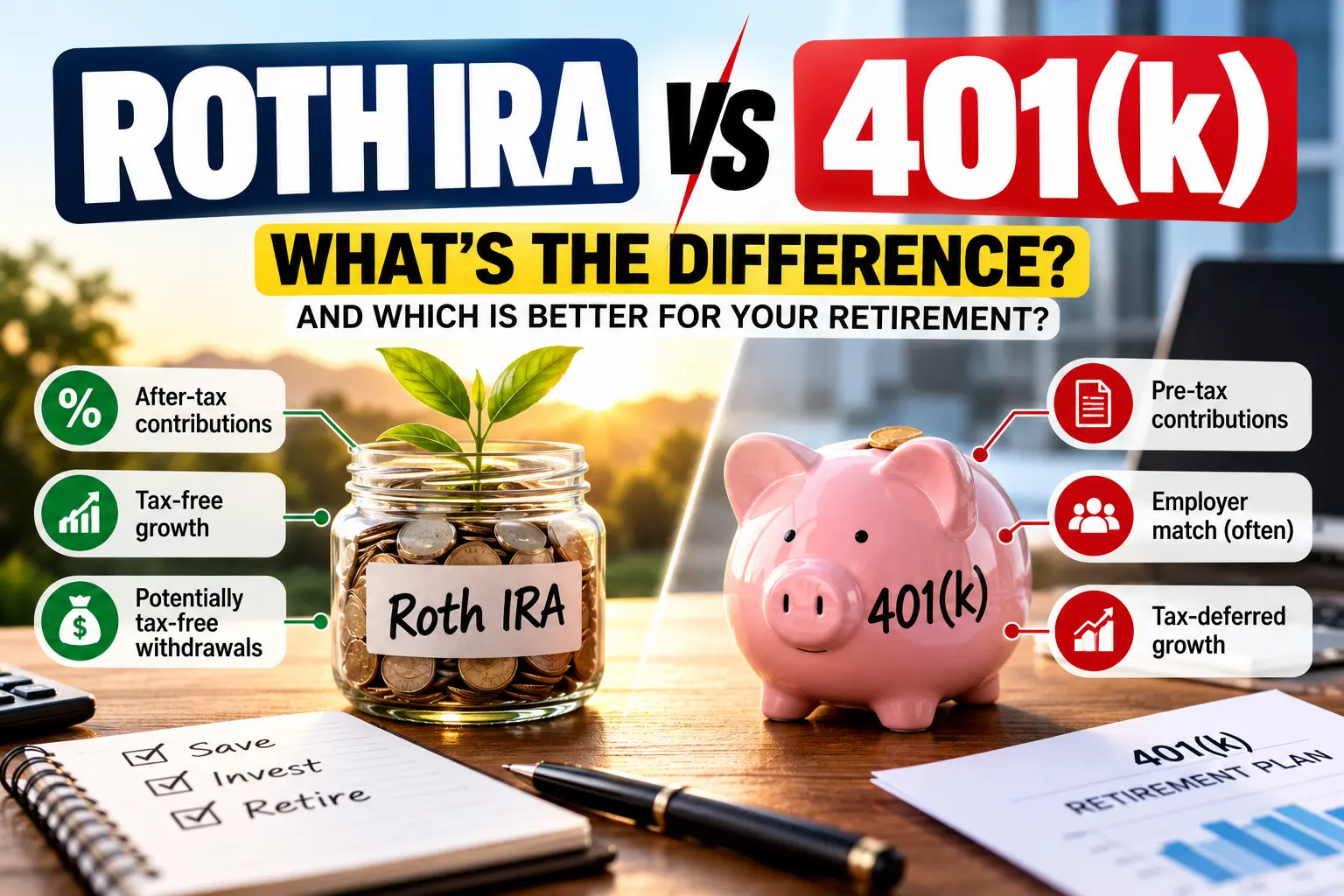
The most important difference is how they handle taxes. A traditional 401(k) generally gives you a tax break when you contribute, while a Roth IRA uses money you’ve already paid income tax on and can provide tax-free qualified withdrawals later.
There is another important detail: a 401(k) is usually offered through an employer, while an IRA is an individual retirement account you can open yourself if you meet the eligibility requirements.
Understanding these differences can help you decide where your retirement money should go, how much you can save, and how to avoid missing valuable benefits.
This guide explains how Roth IRAs and 401(k)s work, their advantages and disadvantages, the 2026 contribution limits, and practical ways to decide which account makes sense for you.
This article focuses on the U.S. retirement system. Tax rules, eligibility requirements, and contribution limits can change, so verify current rules before making financial decisions.
What Is a Roth IRA?
A Roth IRA is an individual retirement account that allows eligible people to invest money for retirement using after-tax dollars.
In simple terms, you pay income tax on the money before contributing it. You can then invest that money inside the account, and your investments can grow over time. If you meet the requirements for a qualified withdrawal, you can take the money out in retirement without paying federal income tax on the withdrawal.
That last point is what makes a Roth IRA attractive.
Imagine you contribute $5,000 to a Roth IRA and invest it in a diversified portfolio. Over the years, your investments increase in value.
Eventually, your original contribution and investment earnings could be worth considerably more than $5,000.
If your withdrawal qualifies under Roth IRA rules, you generally won’t owe federal income tax on that distribution.
You paid tax on the money before contributing it, so you may receive the benefit of tax-free qualified withdrawals later.
How does a Roth IRA work?
The process is relatively straightforward.
- You earn income and pay applicable taxes.
- You open a Roth IRA with an eligible financial institution.
- You contribute money, subject to annual limits and income eligibility rules.
- You choose investments available through your account provider.
- Your investments may grow over the years.
- You take qualified distributions in retirement, generally without federal income tax on those withdrawals.
One detail deserves attention: opening a Roth IRA does not automatically mean your money is invested.
Depending on the provider, contributions may initially sit in cash. You typically need to select investments yourself or choose an appropriate managed option.
The Roth IRA is the account. The investments are what you hold inside it.
That distinction matters because money sitting uninvested for decades may not achieve the long-term growth you expected.
Who can contribute to a Roth IRA?
Roth IRA contributions are subject to earned-income and modified adjusted gross income rules.
For 2026, the regular annual contribution limit is $7,500, or $8,600 for people age 50 or older, subject to the applicable compensation and eligibility requirements. The amount you can contribute directly may be reduced or eliminated at higher income levels.
A Roth IRA can be particularly attractive to people who:
- Expect to be in a similar or higher tax bracket in retirement.
- Want the possibility of tax-free qualified withdrawals.
- Prefer to choose and manage their own investments.
- Want a retirement account that isn’t tied to their current employer.
- Want flexibility around withdrawing their original contributions, subject to the applicable ordering rules.
However, a Roth IRA isn’t automatically the best choice for everyone. Someone who needs a tax deduction today, for example, may prefer to investigate a traditional 401(k) or traditional IRA.
The important thing is to understand when the tax benefit occurs and whether it matches your financial situation.
What Is a 401(k)?
A 401(k) is an employer-sponsored retirement savings plan that allows eligible employees to contribute part of their paycheck toward retirement.
Instead of receiving your entire paycheck and then manually transferring money into an investment account, you can generally arrange for contributions to come directly out of your salary.
Many employers also offer matching contributions. This means your employer may add money to your retirement account when you contribute, subject to the rules of the plan.
For example, your employer might match 50 cents for every dollar you contribute, up to a specified percentage of your salary.
If you contribute $200 per paycheck, your employer might add another $100 if your contributions qualify for that match.
That’s additional retirement money you wouldn’t receive if you ignored the benefit.
The exact matching formula, eligibility requirements and vesting rules depend on your employer’s plan.
How does a traditional 401(k) work?
With a traditional 401(k), contributions are generally made from your paycheck before federal income tax is calculated on that income.
This can lower your current taxable income.
Your investments can then grow tax-deferred. When you withdraw the money in retirement, distributions are generally subject to ordinary income tax.
Here’s a simple example.
Suppose you earn $70,000 a year and contribute $7,000 to a traditional 401(k).
Ignoring other adjustments and assuming the contribution is fully eligible for the normal tax treatment, your federal taxable wages could be reduced by $7,000.
You don’t avoid taxes forever. Instead, you generally postpone paying income tax on that contribution until you withdraw the money.
The potential benefit is that you get a tax break today while building retirement savings for tomorrow.
The potential downside is that you must consider what tax rates and withdrawal rules will look like when you retire.
What can you invest in through a 401(k)?
Your choices depend on the plan offered by your employer.
Many plans provide access to:
- Mutual funds
- Index funds
- Target-date retirement funds
- Bond funds
- Other plan-approved investment options
You may not have the same investment flexibility that you’d get from an individual brokerage account.
However, a well-designed 401(k) can provide a straightforward way to invest regularly without having to make every contribution manually.
According to Investor.gov, employer-sponsored 401(k) plans commonly offer investment choices such as mutual funds and target-date funds.
The main advantage is convenience.
You establish your contribution percentage, choose investments that fit your goals, and let the process run through your payroll.
You still need to review your investments, fees and contribution rate occasionally, but you don’t have to start from scratch every payday.
Roth IRA vs. 401(k): The Main Differences
The most important thing to understand is that a Roth IRA and a 401(k) are not exactly equivalent types of accounts.
A Roth IRA is an individual account with Roth tax treatment.
A 401(k) is an employer-sponsored retirement plan that may offer traditional contributions, Roth contributions, or both.
Here’s how they compare.
| Feature | Roth IRA | Traditional 401(k) |
|---|---|---|
| Where you open it | Through an eligible financial institution | Through your employer |
| Contributions | After-tax money | Generally pre-tax money |
| Tax benefit | Potentially tax-free qualified withdrawals | Potential tax reduction today |
| Investment growth | Tax-free for qualified distributions | Tax-deferred until withdrawal |
| 2026 employee contribution limit | $7,500, subject to eligibility | $24,500 |
| Income restrictions | Direct contributions are income-limited | Generally no comparable income limit for employee deferrals |
| Employer match | Not normally available | May be available |
| Investment choices | Depends on your provider | Limited to the plan’s menu |
| Access to original contributions | Generally flexible under Roth IRA ordering rules | Usually more restricted |
| Required minimum distributions | None during the original owner’s lifetime | Generally apply to traditional 401(k) accounts |
The contribution limits above are for 2026 and assume regular employee contributions rather than special catch-up amounts. Roth IRA eligibility and withdrawal rules require additional consideration.
One important distinction: a Roth 401(k) also exists.
If your employer offers a Roth 401(k), you can contribute after-tax money through your workplace plan and potentially receive tax-free qualified withdrawals later.
That means the real comparison can involve three options:
- Traditional 401(k)
- Roth 401(k)
- Roth IRA
Each has different rules, and the right combination depends on your circumstances.
Roth IRA vs. 401(k): How the Taxes Work
Taxes are one of the biggest reasons people compare these retirement accounts.
The decision often comes down to this question:
Would you rather receive a tax benefit now or potentially receive one when you withdraw the money in retirement?
Traditional 401(k): Potential tax benefits today
With a traditional 401(k), eligible contributions generally reduce the amount of income subject to current federal income tax.
Your investments grow tax-deferred, and distributions are generally taxed as ordinary income.
This arrangement can be particularly attractive if you’re currently in a relatively high tax bracket and expect to have a lower taxable income in retirement.
For example, imagine you’re earning a salary that places some of your income in the 24% federal marginal tax bracket.
If you contribute an additional $5,000 to a traditional 401(k), that contribution could reduce your current federal income tax by approximately $1,200, assuming the entire contribution would otherwise have been taxed at 24%.
That’s an illustration, not a guaranteed saving. Your actual tax benefit depends on your full tax situation.
The money remains invested for retirement, and you generally pay income tax when you take distributions.
Roth IRA: Potential tax benefits later
With a Roth IRA, you contribute money after paying applicable taxes.
You don’t receive a federal income-tax deduction for a regular Roth IRA contribution.
However, qualified withdrawals can generally be tax-free, including investment earnings.
For a Roth IRA distribution to be qualified, the applicable five-tax-year requirement generally must be satisfied, and the distribution must meet an additional qualifying condition, such as reaching age 59½, subject to certain exceptions.
This is why starting early can be attractive.
You may have decades for your investments to grow before retirement, and qualified withdrawals can avoid federal income tax on that growth.
Which tax approach is better?
Neither approach is automatically superior.
Consider two hypothetical investors.
Investor A earns a high income today and expects a lower tax rate in retirement. A traditional 401(k) could provide a valuable current deduction.
Investor B is early in their career, earns a more modest income and expects their earnings to increase substantially over time. A Roth IRA or Roth 401(k) might be attractive because they pay taxes at their current rates in exchange for the possibility of tax-free qualified withdrawals later.
But future tax rates are uncertain, and career income alone doesn’t determine the answer.
Retirement spending, Social Security, pensions, investment income, state taxes and other circumstances can all influence the result.
The practical lesson is to compare the value of the tax break today with the potential value of tax-free withdrawals later.
2026 Contribution Limits: Roth IRA vs. 401(k)
Contribution limits matter because they determine how much money you can put into these accounts each year.
For 2026, the regular limits are:
Roth IRA
$7,500
Or $8,600 if age 50 or older
401(k)
$24,500
Generally $32,500 for age 50+; special higher catch-up rules apply at ages 60–63
The IRS confirms that the 2026 employee deferral limit for most 401(k) plans is $24,500, while the combined traditional and Roth IRA contribution limit is $7,500, or $8,600 for eligible people age 50 and older.
These limits apply differently.
Roth IRA limits
The $7,500 limit is the combined annual contribution limit for your traditional and Roth IRAs.
It isn’t $7,500 for each account.
If you contribute $4,000 to a Roth IRA and $3,500 to a traditional IRA in 2026, you have used the full $7,500 regular annual limit, assuming you’re otherwise eligible.
Your contribution may also be limited by your eligible compensation and Roth IRA income restrictions.
For 2026, the Roth IRA modified adjusted gross income phase-out range is $153,000–$168,000 for single filers and heads of household, and $242,000–$252,000 for married couples filing jointly. Different rules apply to married people filing separately.
401(k) limits
The regular 2026 employee contribution limit is $24,500.
This is a combined limit for your traditional and Roth 401(k) employee salary deferrals across applicable plans, rather than a separate $24,500 allowance for each type.
Employer matching contributions are treated separately from your employee deferral limit, although broader annual plan limits also apply.
Can you contribute to both?
Yes. If you’re eligible, you can contribute to a Roth IRA and a 401(k) in the same year.
The accounts have separate contribution limits.
For example, an eligible employee could contribute $7,500 to a Roth IRA and $24,500 to a 401(k) in 2026, for a total of $32,000 in personal retirement contributions.
You don’t have to choose one account exclusively.
In fact, using both accounts can be an effective way to diversify the tax treatment of your retirement savings.
Does a 401(k) Employer Match Make It Better Than a Roth IRA?
For many employees, the employer match is one of the most valuable features of a workplace retirement plan.
Imagine your employer offers to match 100% of your contributions up to 4% of your eligible salary.
If your eligible salary is $60,000, contributing 4% means putting in $2,400 annually.
If you qualify for the full match, your employer contributes another $2,400.
You now have $4,800 going into the plan from a personal contribution of $2,400, before investment gains, losses or other adjustments.
That’s why it often makes sense to contribute enough to receive the full employer match when you can afford to do so.
However, check the details.
Some employers match each paycheck, some require you to remain employed for a particular period to keep certain employer contributions, and some plans have special matching rules.
Also, matching contributions are not necessarily free of future tax. Traditional employer contributions are generally taxable when distributed, and the treatment of employer contributions associated with Roth accounts depends on the applicable rules and plan structure.
A Roth IRA usually cannot provide the same employer match.
That doesn’t mean the Roth IRA is inferior. It simply has a different purpose.
The workplace plan may offer matching money and a higher contribution limit, while the Roth IRA may provide greater investment flexibility and different withdrawal features.
Roth IRA vs. 401(k): Which Is Better for Beginners?
If you’re just starting your career and retirement seems decades away, the decision can feel more complicated than it needs to be.
You don’t have to predict your entire financial future before making your first contribution.
Instead, consider the options in a sensible order.
Option 1: Start with the 401(k) match
If your employer offers a match, find out how much you need to contribute to receive the full benefit.
If your budget allows, contributing enough to qualify for the full match can be a sensible first step.
Option 2: Consider a Roth IRA
After taking advantage of the available employer match, a Roth IRA may be worth considering if you qualify.
It can provide access to a different investment menu and the potential for tax-free qualified withdrawals.
Option 3: Increase your 401(k) contributions
If you’re able to save more, you can increase your workplace contributions.
The higher 401(k) contribution limit can be especially useful for employees who want to save a substantial portion of their income.
This is a general framework, not a universal rule. Someone with high-interest debt, no emergency savings or unusual tax circumstances may need to adjust the order.
The important thing is to start with a plan you can sustain rather than waiting until you understand every detail of retirement planning.
Can You Withdraw Money From a Roth IRA or 401(k) Early?
Access to your money is another important difference.
A Roth IRA generally provides more flexibility for withdrawing your own contributions than a traditional 401(k), but that doesn’t mean every withdrawal is tax-free or penalty-free.
Roth IRA withdrawals
Roth IRA distributions follow specific ordering rules.
In general, regular contributions are treated as withdrawn before conversions and investment earnings. Because regular contributions were made with after-tax money, withdrawing those contributions usually doesn’t create income tax or an early-withdrawal penalty.
However, conversions and earnings can have different tax and penalty consequences.
Investment earnings generally need to meet the applicable qualified-distribution requirements to receive the full tax-free treatment.
For this reason, a Roth IRA shouldn’t automatically be treated as a regular savings account.
Money invested for retirement should ideally remain invested for the long term.
401(k) withdrawals
A traditional 401(k) generally has more restrictions around accessing your money while you’re employed.
Depending on your plan, access may be available through eligible distributions, loans or hardship withdrawals, but the rules vary.
Traditional 401(k) distributions are generally subject to ordinary income tax, and withdrawals before age 59½ may also incur an additional 10% tax unless an exception applies.
Investor.gov explains that traditional 401(k) contributions and earnings are generally taxed when withdrawn and that early distributions may be subject to an additional tax.
Before withdrawing money early, understand the potential taxes, penalties, lost investment growth and effect on your retirement goals.
What Happens When You Retire?
Retirement is when the differences in tax treatment become particularly important.
With a traditional 401(k), you generally pay ordinary income tax on taxable distributions.
With a Roth IRA, qualified distributions are generally tax-free.
A Roth 401(k) can also provide tax-free qualified distributions if the applicable requirements are satisfied.
These differences can affect how you manage retirement income.
For example, someone with traditional retirement accounts may have to consider how taxable withdrawals affect their overall taxable income.
Someone with Roth savings may have more flexibility to take qualified distributions without increasing federal taxable income.
But this doesn’t mean Roth accounts are always better.
If you receive a valuable tax deduction today by contributing to a traditional 401(k), the tax savings could help you invest more now.
If your tax rate in retirement is lower, that strategy may work well.
The challenge is that nobody knows every detail of their future tax situation.
One practical approach is to consider holding both traditional and Roth retirement assets, when appropriate, so that you have more than one source of retirement income with different tax treatment.
Also remember that required minimum distribution rules differ by account type. Traditional 401(k)s generally have required minimum distributions, while the original owner of a Roth IRA generally does not. Roth 401(k) rules have changed in recent years, so confirm current requirements rather than assuming all retirement accounts follow identical rules.
Should You Have Both a Roth IRA and a 401(k)?
For many people, having both can be useful.
Think of them as two different tools rather than competing products.
A 401(k) can help you save larger amounts through payroll deductions and potentially receive an employer match.
A Roth IRA can provide another place to invest for retirement and may offer more choice over investments and custodians.
Holding both may also give you more flexibility when deciding which accounts to draw from in retirement.
However, don’t open multiple accounts just to collect account numbers.
Before contributing, consider whether you have enough emergency savings, whether you’re carrying expensive debt, and whether the investments and fees in each account make sense.
A simple strategy you can follow consistently is generally more useful than a complicated strategy you abandon after a few months.
Common Mistakes to Avoid
1. Ignoring the employer match
If you have access to a valuable match and can afford to qualify for it, ignoring it could mean missing out on compensation tied to your retirement savings.
2. Assuming Roth contributions are tax-deductible
Roth IRA contributions are generally made with after-tax money and do not provide the same upfront federal income-tax deduction as eligible traditional 401(k) contributions.
3. Forgetting to invest the contributions
Funding an account is only one step. You also need an investment strategy suitable for your goals, time horizon and tolerance for risk.
4. Contributing more than the permitted amount
IRA contributions are subject to annual limits and eligibility rules. Check your combined traditional and Roth IRA contributions before making additional deposits.
5. Choosing investments without checking fees
Investment expenses can reduce long-term returns. Compare fund expense ratios, plan fees and account charges before deciding where to invest.
6. Treating retirement savings as emergency cash
Early withdrawals may involve taxes, penalties or lost growth. Maintain appropriate emergency savings outside retirement accounts when possible.
7. Believing one tax strategy works for everyone
Your current income, future retirement income, filing status and tax circumstances matter. Avoid choosing an account based solely on someone else’s situation.
Frequently Asked Questions
Is a Roth IRA better than a 401(k)?
Neither is automatically better. A Roth IRA may be attractive for tax-free qualified withdrawals and investment flexibility. A 401(k) may offer an employer match, higher contribution limits and convenient payroll deductions.
Can I have a Roth IRA and a 401(k) at the same time?
Yes. Eligible individuals can contribute to both in the same year, subject to the separate rules and limits for each account.
Is a Roth 401(k) the same as a Roth IRA?
No. Both use after-tax contributions and can provide tax-free qualified withdrawals, but they have different contribution limits, eligibility rules, account structures and withdrawal requirements.
Does a Roth IRA reduce my taxable income?
Generally, no. Regular Roth IRA contributions are made with after-tax dollars and do not provide a federal income-tax deduction.
Does a traditional 401(k) reduce my taxes?
Eligible traditional 401(k) contributions generally reduce current federal taxable income. The eventual tax benefit depends on your circumstances and the taxes due when you withdraw the money.
How much can I contribute in 2026?
The regular Roth and traditional IRA contribution limit is $7,500 combined, or $8,600 for eligible people age 50 or older. The regular employee 401(k) deferral limit is $24,500, with additional catch-up contributions available for eligible older workers
Can I withdraw Roth IRA contributions whenever I want?
Regular Roth IRA contributions are generally available under the Roth IRA ordering rules, but conversions and earnings have different rules. Qualified distributions and early-withdrawal treatment depend on the applicable requirements.
What if my employer doesn’t offer a 401(k)?
You can still consider an IRA if you meet the eligibility requirements. Depending on your circumstances, other retirement options may be available as well.
Final Verdict: Roth IRA vs. 401(k)
The Roth IRA versus 401(k) debate becomes much easier once you understand what each account is designed to do.
A Roth IRA lets eligible investors contribute after-tax money and potentially withdraw qualified distributions tax-free in retirement.
A traditional 401(k) lets employees save through their workplace, generally receive an upfront federal income-tax benefit on eligible contributions, and pay taxes on taxable distributions later.
A Roth 401(k) combines workplace-plan access with Roth tax treatment.
If your employer offers a match, investigate how to receive the full benefit. Then consider whether a Roth IRA, additional 401(k) contributions or a combination of both best fits your income, tax situation and long-term goals.
You don’t need to save the maximum amount immediately.
You don’t need to predict future tax rates perfectly.
And you don’t need to find one account that solves every retirement challenge.
What matters is building a sustainable saving habit, choosing appropriate investments, understanding the rules and increasing your contributions when your finances allow.
The best retirement account is the one that fits your situation and helps you consistently build the future you want.
This article is for educational purposes only and is not individualized tax, legal or investment advice. Contribution limits and tax rules are based on U.S. federal rules for 2026. Consult the IRS or a qualified tax professional for advice specific to your circumstances.