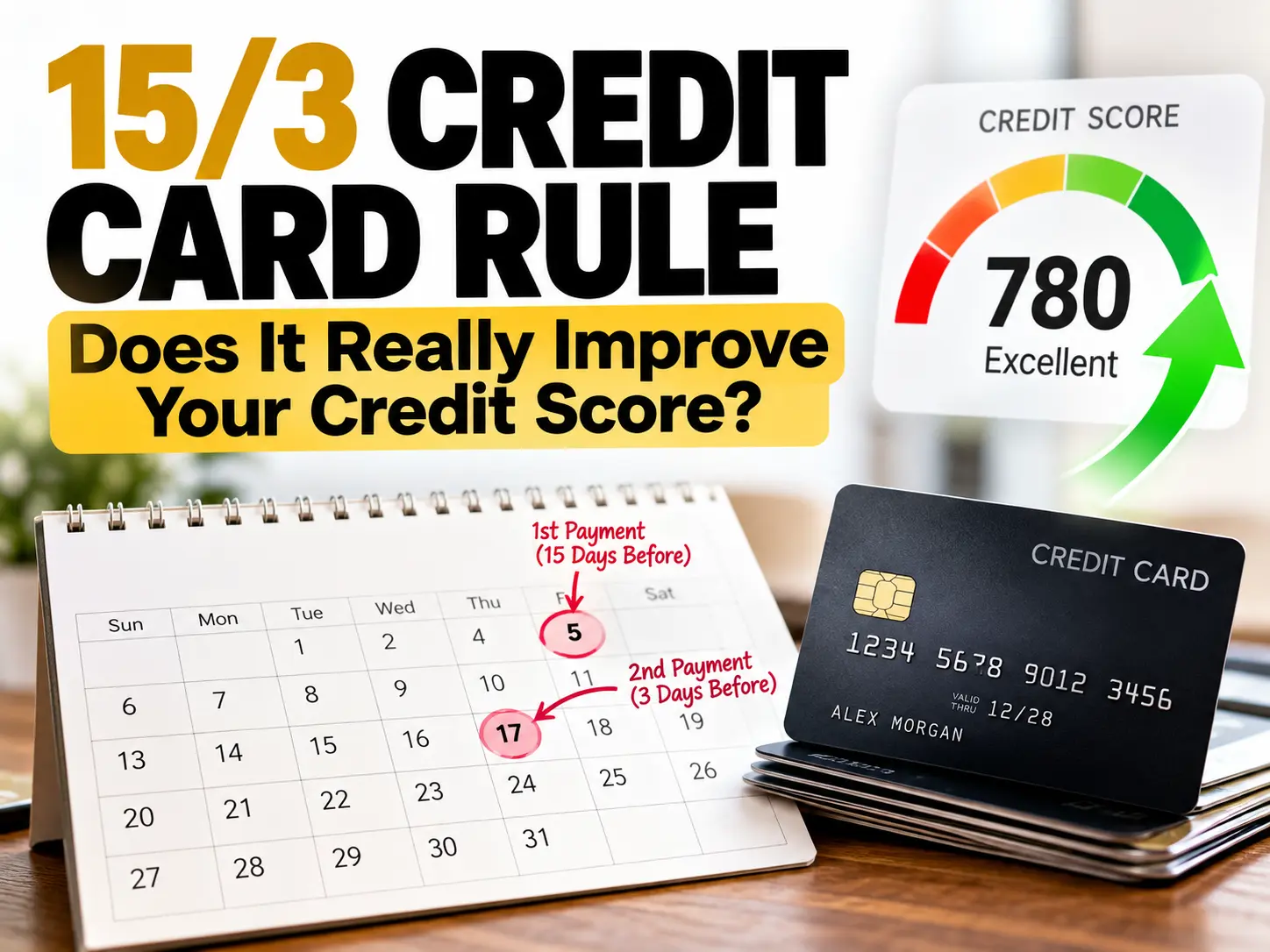
If you have spent any time on TikTok, YouTube, Instagram, or personal finance blogs, you have probably come across the 15/3 credit card rule.
The idea sounds simple:
Make one credit card payment 15 days before your due date, then make another payment 3 days before the due date.
People often claim that this little trick can dramatically improve your credit score, lower your credit utilization, and even make credit card companies see you as a more responsible borrower.
But there is an important problem with that advice.
The 15/3 credit card rule is not an official credit-scoring rule.
Making two payments instead of one does not automatically give you extra points. In fact, the exact “15 days and 3 days before the due date” schedule may have little or no effect on your credit score.
That doesn’t mean the idea is completely useless.
There is a real credit-management strategy hiding underneath the viral hack: paying down your credit card balance before the balance is reported to the credit bureaus can sometimes reduce your reported credit utilization.
And that can matter.
So, what actually happens when you follow the 15/3 method? When should you pay your credit card? And is there a better way to use this strategy?
Let’s break it down.
What Is the 15/3 Credit Card Rule?
The 15/3 credit card rule is a payment strategy that became popular on social media.
The basic idea is to make two payments during your billing cycle:
- Make a payment 15 days before your credit card payment due date
- Make another payment 3 days before your due date
- Pay whatever remaining amount is necessary by the actual due date
For example, imagine your credit card payment is due on the 20th of every month.
Following the 15/3 method would mean:
- 5th: Make the first payment
- 17th: Make the second payment
- 20th: Make sure the required amount has been paid by the due date
Some versions of the method suggest paying half of your balance during the first payment and the remaining balance during the second payment.
The exact amounts aren’t consistent across the different versions of the 15/3 rule.
That’s already a clue that there isn’t some official formula behind it.
The real question isn’t whether you paid exactly 15 days and 3 days before your due date.
The real question is:
What balance does your credit card issuer report to the credit bureaus, and when does it report it?
That is where things get interesting.
Does the 15/3 Rule Actually Improve Your Credit Score?
Not necessarily.
Experian specifically explains that the 15/3 credit card hack does not necessarily improve your credit score simply because you make payments 15 and 3 days before the due date. Experian
There are two different ideas that often get mixed together.
Claim #1: Two payments create two positive payment records
This is generally false.
Your credit report doesn’t normally work like this:
Payment #1 = +1 credit score point
Payment #2 = +1 credit score point
Making multiple payments during the month doesn’t create multiple monthly “on-time payment” rewards.
Your account can be reported as current or delinquent, depending on your payment history. The number of payments you make during the month isn’t what creates extra positive payment-history entries. Experian
Claim #2: Paying early can reduce your reported balance
This part has some truth.
Credit card issuers generally report account information to the credit bureaus periodically. The timing can vary by issuer, but the statement closing date is often important.
If you have a $10,000 credit limit and your reported balance is $4,000, your utilization is:
$4,000 ÷ $10,000 = 40%
If you pay $3,000 before the balance is reported and the reported balance becomes $1,000:
$1,000 ÷ $10,000 = 10%
That’s a meaningful difference.
So the useful part of the 15/3 method isn’t really 15/3.
It’s controlling the balance that gets reported.
Why Credit Card Utilization Matters
Credit utilization is the amount of revolving credit you’re using compared with the amount available to you.
The basic calculation looks like this:
Credit Utilization = Credit Card Balance ÷ Credit Limit × 100
Suppose you have:
Credit limit: $5,000
Balance: $2,000
Your utilization would be:
$2,000 ÷ $5,000 = 40%
Now suppose you pay $1,500 before the relevant balance is reported.
Your reported balance becomes $500.
That’s:
$500 ÷ $5,000 = 10%
The difference is significant.
FICO says the “amounts owed” category accounts for roughly 30% of a typical FICO Score, and credit utilization is an important part of that category. Generally, lower credit card balances are better for your FICO scores. myFICO
That does not mean everyone needs to obsess over reaching exactly 10%.
It also doesn’t mean you should stop using your credit card.
It means that allowing your cards to regularly report very high balances can potentially work against you.
Statement Date vs. Due Date: The Part Most People Miss
This is probably the most important concept to understand if you’re researching the 15/3 credit card rule.
Your statement closing date and your payment due date are not the same thing.
Think of your credit card as having two important dates.
Statement closing date
This is roughly when your billing cycle ends and your statement is generated.
Payment due date
This is the date by which you need to make the required payment to avoid being considered late.
There can be several weeks between these dates.
That means you could have:
Statement closes → balance is reported → several weeks pass → payment due
This creates an important situation.
You could pay your entire credit card bill by the due date and still have a relatively high balance reported during the previous part of the cycle.
The Consumer Financial Protection Bureau explains that credit scores can be calculated at different times, so a high balance on the day your score is calculated can affect your score even if you pay that balance off shortly afterward. Consumer Financial Protection Bureau
This is why simply saying:
“Always pay 3 days before your due date”
isn’t a complete strategy.
You need to understand your own card’s billing cycle.
A Simple Example of Why the 15/3 Rule Can Fail
Let’s say your credit card has:
Credit limit: $10,000
Statement closing date: June 5
Payment due date: June 28
Now imagine that on June 4, you have a $5,000 balance.
If your issuer reports the balance around the statement closing date, that $5,000 could potentially appear on your credit report.
Your utilization would be:
$5,000 ÷ $10,000 = 50%
Now suppose you follow the viral 15/3 method.
You make a payment on June 13.
Then another payment on June 25.
You’ve followed the “15/3” concept.
But notice something:
June 5 already happened.
If the issuer reported the balance around the statement closing date, your June 13 and June 25 payments may not change that previously reported balance.
So you followed the rule perfectly and potentially achieved nothing for utilization.
This is why the calendar dates themselves aren’t magical.
So When Should You Actually Pay Your Credit Card?
There are really two different goals.
Goal 1: Avoid late payments
This is the first priority.
Always make at least the required payment by the due date.
Better yet, if you can afford it, pay the statement balance in full.
FICO identifies payment history as the most important category in its scoring model, accounting for 35% of a typical FICO Score. myFICO
A complicated payment strategy is useless if it causes you to miss the actual due date.
That’s why automatic payments can be extremely helpful.
Set autopay for at least the minimum required amount so that an accidental missed payment doesn’t destroy your otherwise good record.
Then, if you prefer, make additional manual payments.
Goal 2: Keep Your Reported Utilization Low
This is where early payments can make sense.
Instead of blindly following the 15/3 schedule, find out:
When does my credit card issuer typically report my balance?
If you know that your statement closes on the 8th, for example, you may choose to pay down part of your balance before the statement closes.
That can potentially result in a lower reported balance.
Experian notes that paying down a balance before the end of the billing cycle can lower the reported balance and potentially reduce utilization. Experian
That’s a much more logical strategy than memorizing “15 and 3.”
Do You Need to Keep a Balance to Build Credit?
No.
This is another credit card myth that refuses to die.
Some people believe that paying the entire balance every month means the credit card company won’t see you using the card.
Others believe that carrying a small balance helps build credit.
You don’t need to pay interest to build a good credit history.
The CFPB specifically states that you don’t need to carry a balance on your credit cards to have a good credit score. Consumer Financial Protection Bureau
In fact, carrying a balance can mean paying unnecessary interest.
Imagine you have a $2,000 balance and your card charges a high APR.
Keeping that balance around simply because you think it will help your credit score can cost you real money.
A better strategy is usually:
Use the card responsibly → keep balances manageable → pay on time → ideally pay the statement balance in full.
Is 30% Credit Utilization the Magic Number?
You’ve probably heard:
“Never use more than 30% of your credit limit.”
There’s some useful guidance behind this, but 30% isn’t a magical cliff.
The CFPB and other consumer-credit resources commonly advise keeping utilization below 30%, while some experts recommend keeping it even lower. Consumer Financial Protection Bureau
Consider a $10,000 credit limit.
50% utilization
$5,000 balance
30% utilization
$3,000 balance
10% utilization
$1,000 balance
5% utilization
$500 balance
Generally, lower utilization is better than very high utilization.
But don’t turn this into another obsession where you’re constantly making payments just to hit a particular percentage.
If you’re using your card normally and paying it off every month, you’re already doing one of the most important things.
What About 1% Utilization?
You’ll sometimes see another internet rule:
“You need exactly 1% utilization for the best credit score.”
Again, there is no universal 1% rule that applies to everyone.
Credit scoring models are complicated, and different scoring models can evaluate credit information differently.
Your score also depends on much more than one credit card balance.
The CFPB lists factors such as payment history, how close you are to your credit limit, length of credit history, number of accounts, and recent credit applications among the information that can affect credit scores. Consumer Financial Protection Bureau
So don’t sacrifice your financial stability just to manufacture a tiny reported balance.
What the 15/3 Rule Gets Right
The viral rule isn’t completely worthless.
It encourages several good behaviors.
1. You’re paying attention to your credit card
Many people don’t look at their balances until the bill arrives.
Checking your balance throughout the month can help prevent surprises.
2. You’re making payments early
Early payments can help you manage cash flow and potentially reduce the balance reported to credit bureaus.
3. You’re less likely to miss a payment
If you make payments throughout the month, you may be less likely to forget the bill entirely.
4. It can work well with biweekly income
Someone who gets paid twice a month may prefer dividing their credit card payments between paychecks rather than trying to find a large amount of money at the end of the month.
So there’s nothing inherently bad about making multiple credit card payments.
The problem is believing that 15 days and 3 days are magical numbers.
They aren’t.
What the 15/3 Rule Gets Wrong
There are several claims surrounding the method that you should be skeptical about.
Myth 1: Two payments create two positive credit entries
No.
Your credit report doesn’t give you bonus points simply because you made two payments instead of one.
Myth 2: Paying exactly three days before the due date lowers utilization
Not necessarily.
If your issuer has already reported the balance, paying three days before the due date may not change that reported balance.
Myth 3: You must carry a balance
No.
You don’t need to pay interest to build credit.
Myth 4: Everyone should follow exactly the same schedule
No.
Your statement cycle, issuer reporting practices, credit limits, balances and overall credit profile are different.
Myth 5: The 15/3 rule can dramatically increase your score
There is no guaranteed number of points you’ll gain by following it.
Your credit score isn’t controlled by a single payment trick.
A Better Credit Card Strategy Than the 15/3 Rule
Instead of remembering an arbitrary formula, use this five-step system.
Step 1: Know your credit limit
Check the limit on every revolving credit account.
Knowing your available credit makes it easier to understand your utilization.
Step 2: Know your statement closing date
Look at your credit card statement.
Find the date your billing cycle ends.
This is more useful for utilization management than blindly counting backward 15 days from the due date.
Step 3: Set up autopay
Set autopay for at least the minimum payment.
This is your safety net.
The goal is simple:
Never accidentally miss a payment.
The CFPB recommends automatic payments or electronic reminders as ways to help ensure payments are made on time. Consumer Financial Protection Bureau
Step 4: Pay the statement balance in full when possible
If you can comfortably afford it, paying the statement balance in full can help you avoid interest on purchases.
This is usually more important than trying to find a clever payment hack.
Step 5: If necessary, make an early payment before the statement closes
If your balance is getting unusually high compared with your credit limit, consider paying part of it down before the statement closing date.
For example:
You have a $5,000 limit.
You’ve charged $2,500.
That’s 50% utilization.
If you can afford to pay $2,000 before the statement closes, the remaining balance would be $500.
That’s:
$500 ÷ $5,000 = 10%
The important thing isn’t that you followed 15/3.
You simply reduced the balance that may be reported.
What If You Have Multiple Credit Cards?
This gets slightly more complicated.
Suppose you have three cards:
| Card | Limit | Balance |
|---|---|---|
| Card A | $5,000 | $500 |
| Card B | $10,000 | $1,000 |
| Card C | $15,000 | $2,000 |
Your total credit limit is:
$30,000
Your total balance is:
$3,500
Your overall utilization is approximately:
11.7%
That’s fairly different from having $3,500 on a single $5,000 card.
This is why both individual card utilization and overall utilization can matter depending on the scoring model and credit profile.
If one card is nearly maxed out while another has a large unused limit, you shouldn’t assume that the overall percentage tells the entire story.
The exact impact can vary.
Should You Make Credit Card Payments Every Week?
You can, but you don’t necessarily need to.
There’s nothing inherently wrong with paying your card weekly if it fits your budgeting system.
For example:
You spend $200 during the week.
You pay $200.
Then you spend another $300.
You pay $300.
This can be useful if:
- You have trouble controlling spending.
- You want to keep your balance low.
- You get paid weekly.
- You prefer budgeting with smaller payments.
- You want to avoid letting your balance grow.
But don’t confuse good budgeting with a special credit-score hack.
Weekly payments don’t automatically produce a better score simply because they’re weekly.
What Actually Matters More Than the 15/3 Rule?
If you’re serious about improving your credit, focus on the fundamentals.
1. Payment history
This is huge.
A consistent history of paying accounts on time is one of the strongest foundations of good credit. FICO identifies payment history as 35% of its typical score calculation. myFICO
2. Credit utilization
Don’t routinely push your cards close to their limits.
Lower balances generally help.
3. Length of credit history
Older, well-managed accounts can contribute positively to your credit profile.
4. New credit applications
Applying for lots of new credit in a short period can create hard inquiries and may signal increased credit risk.
5. Your overall credit profile
A credit score isn’t based on one number from one credit card.
It is based on the information contained in your credit history and the scoring model being used.
The CFPB emphasizes that there is no secret formula for building strong credit; consistent financial behavior matters far more than a single trick. Consumer Financial Protection Bureau
Does the 15/3 Rule Work for Everyone?
No.
And that’s probably the most important answer.
It could indirectly help someone who has a tendency to report high credit card balances.
For example, imagine someone has a $3,000 credit limit and regularly spends $2,000 during the month but always pays the entire bill by the due date.
They may technically be paying on time every month.
But if their issuer reports a high balance during the billing cycle, their credit utilization could still be relatively high when that information is used in scoring.
Making an early payment before the relevant reporting date could reduce the balance being reported.
But another person might already have:
- low utilization
- automatic payments
- full monthly payments
- no late payments
- a long credit history
For that person, obsessively following 15/3 may accomplish very little.
The Best Way to Think About the 15/3 Credit Card Rule
Forget the numbers for a moment.
Think about the three dates that actually matter:
1. When your billing cycle closes
2. When your balance may be reported
3. When your payment is due
Those dates tell you much more than an internet rule.
Your goal should be:
Before the due date: Make sure the required payment is made.
Before the reporting/statement date: If necessary, reduce a high balance.
Every month: Repeat the process consistently.
That’s a much more flexible strategy.
A Realistic Example
Let’s say Sarah has a credit card with:
Credit limit: $8,000
Statement closing date: August 10
Payment due date: September 4
During the month, she spends $3,200.
If she does nothing, her statement could show approximately $3,200.
That’s:
$3,200 ÷ $8,000 = 40% utilization
Sarah has enough money to pay the entire balance.
Instead of waiting until September 4, she pays $2,400 before the statement closes.
Now her remaining balance is approximately $800.
That’s:
$800 ÷ $8,000 = 10% utilization
She then pays the remaining statement balance by the due date.
Notice what she did.
She didn’t need the 15/3 rule.
She didn’t need to make exactly two payments.
She simply understood when her balance mattered and paid accordingly.
That’s the lesson worth keeping.
Should You Stop Using the 15/3 Rule?
Not necessarily.
If making two payments each month helps you:
- control spending
- avoid late payments
- reduce your reported balance
- manage your cash flow
- pay your statement in full
then there’s nothing wrong with doing it.
Just don’t believe that 15 and 3 are magical numbers.
You could make one payment.
You could make two.
You could make four.
You could pay weekly.
The number of payments isn’t the point.
The timing, amount, and consistency are what matter.
Frequently Asked Questions About the 15/3 Credit Card Rule
What is the 15/3 credit card rule?
The 15/3 credit card rule is a social-media payment strategy that recommends making one credit card payment 15 days before the due date and another 3 days before the due date. It is intended to help manage balances and potentially reduce credit utilization.
Does the 15/3 rule increase your credit score?
Not automatically. There is no official credit-scoring rule that awards points for making payments exactly 15 and 3 days before your due date. Paying early may help if it reduces the balance reported to the credit bureaus, but the effect depends on your account and reporting timing. Experian
Is the 15/3 rule a scam?
Calling it a scam would be too strong. Making multiple payments is a legitimate way to manage a credit card. The misleading part is presenting the specific 15/3 schedule as a guaranteed credit-score hack.
Should I pay my credit card before the statement closes?
If your balance is high relative to your credit limit and you want to reduce the balance that may be reported, paying part of the balance before the statement closes can be useful. However, you should still make sure the required payment is made by the actual due date.
Do I need to carry a balance to build credit?
No. You don’t need to carry a balance or pay credit card interest to build a good credit history. The CFPB explicitly says you don’t need to carry a balance to have a good credit score. Consumer Financial Protection Bureau
Is 30% credit utilization the ideal target?
There is no universal magic number. Keeping utilization below 30% is commonly recommended, but lower utilization can generally be beneficial. Don’t go into debt or pay unnecessary interest just to hit an arbitrary percentage. Consumer Financial Protection Bureau
Is paying my credit card twice a month good?
It can be. Two payments may make budgeting easier and can help keep balances under control. But making two payments by itself does not guarantee a higher credit score.
What is more important than the 15/3 rule?
Consistently paying your bills on time, keeping credit card balances manageable, avoiding excessive new credit applications, and building a longer history of responsible credit use are more important than following a specific payment hack. Consumer Financial Protection Bureau
The Bottom Line
The 15/3 credit card rule sounds like a secret formula.
It isn’t.
There is no magic number of days that guarantees a higher credit score.
But there is a useful idea underneath the viral advice.
Paying your credit card balance before the relevant reporting date can sometimes help keep your reported credit utilization lower.
That’s worth understanding.
The bigger lesson is even simpler:
Don’t focus on hacks. Focus on how your credit card actually works.
Know your credit limit.
Know your statement closing date.
Know your payment due date.
Keep your balances manageable.
Pay on time.
Pay your statement balance in full when you can.
And if your balance gets high before the statement closes, consider making an early payment rather than waiting until the due date.
The goal isn’t to perfectly follow a rule you saw on social media.
The goal is to build a credit history that tells lenders something far more valuable:
You borrow responsibly, you understand your money, and you pay what you owe on time.
That’s a strategy that can still make sense long after the next viral credit-card “hack” disappears from your feed.